Foreword
Our High Frequency Hearing Test was one of our first featured tests, back in 2007. Since then, it has become one of our most popular pages too. Originally, the test was intended to measure the highest frequency one can hear, assessing the very last octaves of our hearing and the frequencies that we are supposed to hear when we are young and in good health. We did not expect this test to be used as a regular hearing test. Although it can be effectively used to measure the upper limit of your hearing down to 8 kHz, it doesn't test the same frequencies as those measured by an audiologist.
Audiologists are interested in frequencies that are important for clear understanding of speech, not the frequencies that make high-fidelity audio recordings enjoyable. Their target frequencies reside in the 125-8,000 Hz range, generally not above that. This page's hearing test assesses the same frequency range.
Sound level calibration is a prerequisite to properly measuring hearing loss. Our hearing test is the only online hearing test we know of that offers you a way to calibrate your headphones or speakers, giving you the opportunity to reliably estimate your hearing loss. Use our test with confidence to confirm normal hearing, or a mild, moderate, or severe hearing loss. This test - like any other hearing test - requires a decent pair of headphones (good speakers will work too, although headphones are preferred), and a quiet environment.
Audiogram
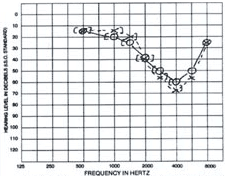
An audiogram is a graph that shows the softest sounds a person can hear at different frequencies. It plots the threshold of hearing relative to an average 'normal' hearing. In this test, the ISO 389-7:2005 standard is used.
Levels are expressed in deciBels Hearing Level (dBHL). dBHL are not absolute but represent the difference between your hearing and the 'normal'.
If you score 0 dBHL, your hearing exactly matches the norm; higher values are signs of hearing loss. There are tolerances though: normal hearing is defined by thresholds lower than 15 dBHL at all frequencies, not strictly at 0 dBHL.
Calibration
Audiograms require a properly calibrated audio system. As we have no idea how loud your sound level has been turned to as you listen to our sound files, running an online audiogram test requires a trick. As imprecise as it is, it will be good enough to provide you with a rough estimate of your hearing loss, if any.
| Calibration File |
First, we need you to adjust your computer's level to match a known reference. Here is the trick: rub your hands together, in front of your nose, quickly and firmly, and try producing the same sound as our calibration file. You are now generating a reference sound that is approximately 65 dBSPL. As you play back our calibration file, adjust your computer's volume to match the sound level you just heard from you hands. Proceed back and forth - preferably with your eyes closed, to increase concentration - until both levels match. Then, do not touch your computer's volume knob anymore. Calibration is done: your computer's volume knob has been set to match 65 dBSPL. This procedure should give us a confidence of approximately 10 dBHL in the next hearing test.
Although headphones for this test are highly recommended, they must be taken off when listening to the reference sound made by your hands.
The sound files
Each frequency will be tested separately, at increasing levels. Always start with the quietest file (-5 dbHL) and stop when your hearing threshold level has been reached.
Files labelled 70 dBHL and above, are meant to detect severe hearing losses, and will play very loud for a normal hearing person!
Interpret your results as follows:
-5 dbHL: Outstanding hearing
0-10 dBHL: Normal Hearing
20-30 dbHL: Mild Hearing Loss
40-60 dBHL: Moderate Loss
70-80 dBHL: Severe Hearing Loss
If you have trouble hearing any of the higher dbHL files, confirm these results by visiting an audiologist.
125 Hz - The low end of male voices
| -5 dBHL | 0 dBHL | 5 dBHL | 10 dBHL | 15 dBHL | 20 dBHL |
| 30 dBHL | 40 dBHL | 50 dBHL | 60 dBHL | 70 dBHL |
Due to restrictions in the dynamic range recorded by the .wav file format, the 125 Hz - 80 dBHL test cannot be performed online.
250 Hz - The low end of female voices
| -5 dBHL | 0 dBHL | 5 dBHL | 10 dBHL | 15 dBHL | 20 dBHL |
| 30 dBHL | 40 dBHL | 50 dBHL | 60 dBHL | 70 dBHL | 80 dBHL |
500 Hz - Low Midrange
| -5 dBHL | 0 dBHL | 5 dBHL | 10 dBHL | 15 dBHL | 20 dBHL |
| 30 dBHL | 40 dBHL | 50 dBHL | 60 dBHL | 70 dBHL | 80 dBHL |
1000 Hz - Midrange
| -5 dBHL | 0 dBHL | 5 dBHL | 10 dBHL | 15 dBHL | 20 dBHL |
| 30 dBHL | 40 dBHL | 50 dBHL | 60 dBHL | 70 dBHL | 80 dBHL |
2000 Hz - Upper Midrange
| -5 dBHL | 0 dBHL | 5 dBHL | 10 dBHL | 15 dBHL | 20 dBHL |
| 30 dBHL | 40 dBHL | 50 dBHL | 60 dBHL | 70 dBHL | 80 dBHL |
4000 Hz - Top of telephone bandwidth
| -5 dBHL | 0 dBHL | 5 dBHL | 10 dBHL | 15 dBHL | 20 dBHL |
| 30 dBHL | 40 dBHL | 50 dBHL | 60 dBHL | 70 dBHL | 80 dBHL |
8000 Hz - Sibiliance
| -5 dBHL | 0 dBHL | 5 dBHL | 10 dBHL | 15 dBHL | 20 dBHL |
| 30 dBHL | 40 dBHL | 50 dBHL | 60 dBHL | 70 dBHL | 80 dBHL |
Reminder
-5 dbHL: Outstanding hearing0-10 dBHL: Normal Hearing
20-30 dbHL: Mild Hearing Loss
40-60 dBHL: Moderate Loss
70-80 dBHL: Severe Hearing Loss
Cross Check
The hearing test featured on this page uses pure tone stimuli. To confirm your results, check out HearingTest.online : it relies on the same calibration protocol, but uses wable tones instead, and offers a neat audiogram printout feature!
Warning
Although our test files have been carefully designed, results using this test cannot be considered as accurate as clinical data. If you are worried about your hearing, please consult your audiologist.
Related pages
Other Frequency Tests
- Our Original High Frequency Response and Hearing Test (22 kHz down to 8 kHz)
- High Frequency Audibility Blind Test (22 kHz down to 12 kHz)
External Links
- What is an Audiogram
- HearingTest.online - the improved version of this test, offering an audiogram printout
Help Me Help You!
Is AudioCheck free? Not for me. Your support keeps this site running. Any donation will be rewarded with • uncompressed .wav file download for every test (a download arrow will appear next to each sound icon) • increased durations and sample rates up to 192 kHz in the Tone Gen section • and, best of all, the removal of these pesky payment buttons below 😜

If you already are a patron, please log in.
Frequency Response Tests
Stereo Imaging Tests
Dynamic Range Test
Room Tests
Distortion Tests
